

What Does the Moon in Your Dream Really Mean? 15 Powerful Interpretations

Quick Take — What a Moon Dream Usually Means
There are nights when the moon in your dream feels like a private messenger — soft, insistent, and oddly familiar. Maybe it’s a full, luminous orb flooding a beach with silver, or a slim crescent hanging like a secret in the sky; either way, that image is not random. The moon in dreams most often points to your inner tides: shifting emotions, intuition, and cycles of change. (If you also dream of water, see our water dream meaning for deeper insight.)
A lunar dream frequently appears when you are ignoring a gut feeling in waking life, urging you to trust your subconscious knowledge over external logic. This pattern commonly appears when navigating a career transition or digital fatigue. For more on how digital life influences dreams, see our guide on being chased in digital dreams.
Just as the moon governs tides, it often represents the natural ebb and flow of your mood, highlighting periods of burnout or emotional overflow. It tends to surface when you are stuck in a repetitive workplace stress loop. If you’re also dreaming of running, this may reflect an attempt to escape these cycles—see our dream of running meaning.
Before diving deep into symbolism, check a lunar calendar. If there was a Full Moon, Supermoon, or Lunar Eclipse in the real world on the night of your dream, your subconscious might simply be reflecting the heightened celestial energy around you.
Full Moon vs Crescent vs New Moon — Phase-by-Phase Meanings
The phase of the moon in your dream acts as a timeline for your emotional state. A shifting phase may suggest a transition, while a static phase often points to a lingering feeling. Additionally, the colour of the moon acts as an emotional modifier: a red moon often signifies a period of "pruning" or intense emotional upheaval, while a blue moon may indicate a rare opportunity. For more on dreams of rarity and opportunity, see our money dream interpretation.
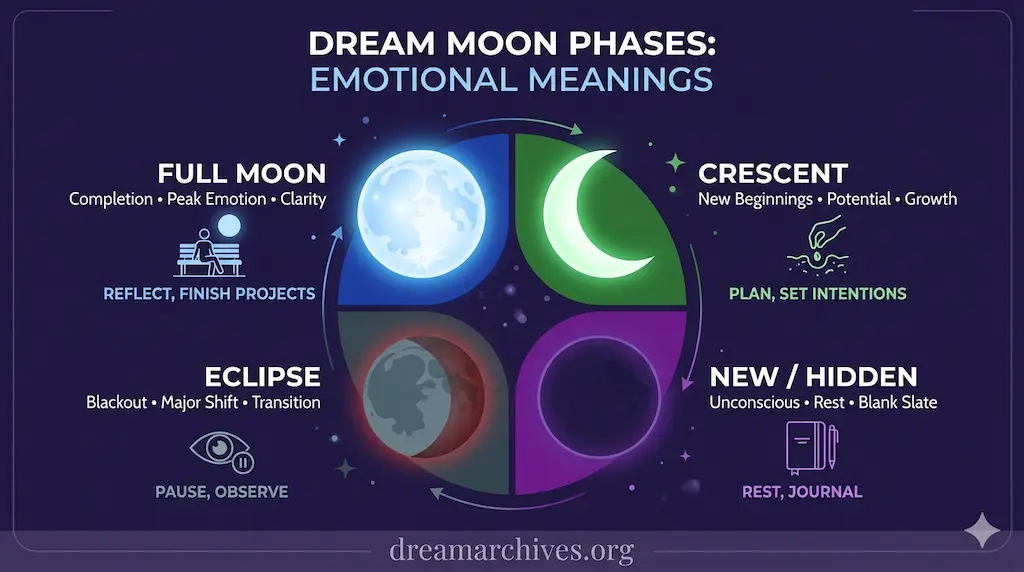
Core Meaning: Completion; heightened emotion; clarity or "overflow."
Emotional Tone: Intense | Action: Reflect; finish projects
Core Meaning: New beginnings; potential; growth happening but early.
Emotional Tone: Hopeful | Action: Plan; set intentions
Core Meaning: The unconscious; rest; a blank slate.
Emotional Tone: Quiet | Action: Rest; journal
Core Meaning: Temporary "blackout" of intuition; a major shift.
Emotional Tone: Apprehensive | Action: Pause; observe
Common Moon Dream Scenarios
The specific action involving the moon often provides the most direct clue to its meaning. Here are the most frequently reported lunar encounters, connecting to modern struggles like identity crisis and relationship transitions. For more on relationship dreams, see our guide on dreaming about an ex.
A giant moon illuminating the landscape may suggest that an emotional situation in your life has grown too large to ignore, demanding your immediate attention. This frequently appears in people who have been in a prolonged state of denial about a relationship issue or a toxic work environment. For more on dreams of overwhelming situations, read our analysis on being chased in architecture dreams.
What to do next: Journaling prompt — What situation currently feels overwhelming but unavoidable?
A falling moon frequently represents a sudden shift in emotional stability or the collapse of an illusion. It commonly surfaces when an abstract anxiety has suddenly become concrete—perhaps a layoff rumor has turned into a real possibility, or a family member's declining health has shifted from "something to worry about later" to "something happening now." This collapse of emotional stability can sometimes be linked to dreams of death or funerals, which you can explore in our death and funeral dream meanings.
What to do next: Journaling prompt — What recent event made you feel like the ground shifted beneath you?
Reaching for and touching the moon often symbolizes connecting with a deeply desired but seemingly impossible goal. This scenario carries a bittersweet quality—the moon is close enough to touch but never quite reachable. It commonly appears during identity crises where you can clearly see the version of yourself you want to become but perceive an insurmountable gap. This aspiration often appears alongside flying dreams—see our flying dream interpretation to understand the connection.
What to do next: Journaling prompt — What aspiration feels close enough to grasp if you just stretch a little further?
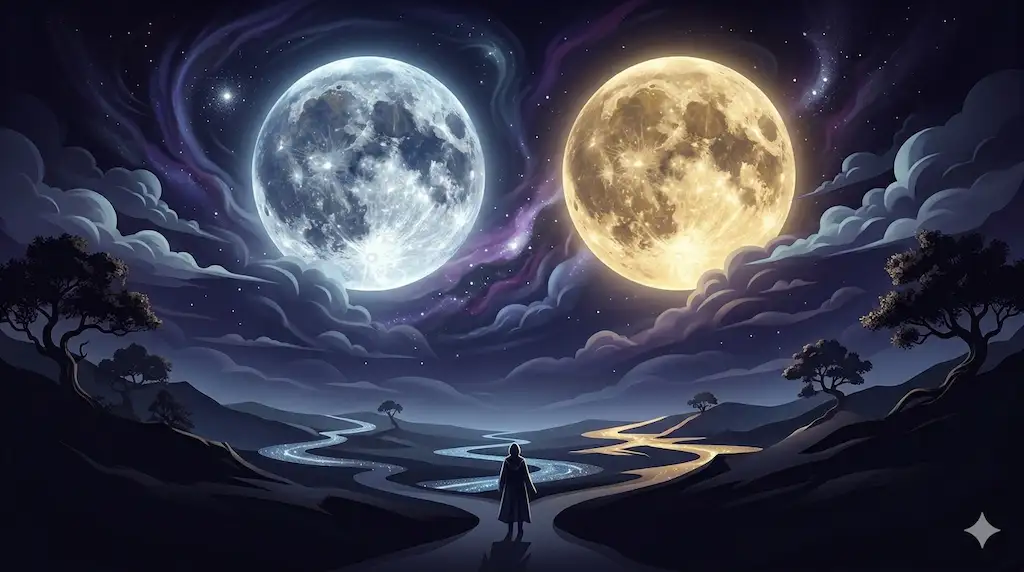
Seeing two moons may indicate being torn between two paths, choices, or dual aspects of your own identity. This "glitch in the matrix" scenario often triggers a visceral sense of wrongness. You're not choosing between opposites—you're being asked to hold two truths at once, and your mind is registering that as impossible. The sense of wrongness and conflict in this dream can also manifest in dreams of being chased in digital spaces, exploring the built and digital environments we navigate—see our being chased in digital dreams guide.
What to do next: Journaling prompt — Where in your life are you trying to walk two diverging paths simultaneously?
An eclipse often points to a temporary "blackout" of intuition or a significant transition where old patterns are obscured before new clarity arrives. This often corresponds to a disconnection from your inner compass, frequently occurring after a period of excessive digital consumption or social media comparison that has drowned out your own intuitive signals. Eclipses often connect to transformation, which can be reflected in dreams of pregnancy—see our pregnant dream scenarios for more.
What to do next: Journaling prompt — What part of your life feels like it is in a transitionary shadow right now?
View More Rare Scenarios
The red color acts as an emotional amplifier. It may signify intense emotional upheaval, suppressed anger that has been pushed down for months, or a health scare that has pulled you out of autopilot mode. The red doesn't necessarily mean danger; it means intensity. Red often signals intensity, which can also appear in dreams of running—see our guide for more.
This dramatic scenario often reflects a catastrophic collapse of an emotional framework—perhaps a belief system that has been shattered by new information, or a long-held assumption about a relationship that has been definitively proven wrong. This collapse can also be explored through death and funeral dreams, which often symbolize the end of a psychological phase.
Given the phrase "once in a blue moon," this dream may point to a rare opportunity or an unusual emotional state that doesn't fit your normal pattern. It frequently appears when someone encounters a situation they've never navigated before. Rare opportunities often relate to value and security—see our money dream interpretation for related symbolism.
Psychological and Jungian Perspectives
Depth Psychology & The Anima
In Jungian psychology, the moon is deeply tied to the "Anima"—the feminine principle within the unconscious mind that governs intuition, receptivity, and emotional wisdom. When the moon features prominently in a dream, it may suggest that you are being called to integrate a neglected emotional dimension of your psyche. This pattern commonly appears when someone has been over-relying on rational structures—such as rigid workplace logic—while suppressing their emotional needs. For more on inner guidance, see our guide on the teacher dream archetype as an inner guide.
"The moon is a symbol of the unconscious, of the feminine principle, and of the rhythmic cycle of psychic transformation."
Research highlighted by the International Association for the Study of Dreams suggests that lunar imagery tends to surge in dreams during periods of identity crisis or significant relationship transitions. For more on identity shifts, see our article on dreaming of hair falling out.
Cognitive & Emotional Processing
From a cognitive perspective, the moon often serves as a visual metaphor for cyclical emotional patterns. If you find yourself trapped in a loop of digital fatigue or workplace stress, your brain may use the moon's orbital rhythm to represent the repetitive nature of these waking struggles. The luminous quality of the moon in dreams may reflect the mind's attempt to bring these shadowy, repetitive anxieties into conscious awareness. For more on repetitive stress patterns, see our analysis on being chased in digital dreams.
"Dreams are the royal road to the unconscious," and celestial bodies often act as the streetlights along that path.
Studies referenced in Sleep Medicine Reviews indicate that dream imagery involving celestial bodies often correlates with elevated amygdala activity during sleep, suggesting that the moon's appearance may not be purely symbolic—it could also reflect heightened emotional processing happening at a neurological level.
Advanced Perspectives
Digital Anthropology: The Screen as Artificial Moonlight
In modern dream analysis, the moon frequently appears as a compensatory symbol for digital fatigue. Before artificial lighting, the moon was the only source of nocturnal illumination. Today, our screens emit a constant, synthetic "moonlight" that disrupts circadian rhythms and floods the brain with stimuli long after dark. When the moon appears shattered, hidden, or overwhelmingly bright in a dream, it may represent the subconscious mind's rebellion against the ambient glow of smartphones and monitors. For more on how digital life influences dream content, read our article on being chased in digital dreams.
This pattern commonly appears when individuals experience "doomscrolling" fatigue—a state where the conscious mind is saturated with information, yet the intuitive mind feels starved of actual insight. The lunar dream, in this context, is less about cosmic symbolism and more about a biological plea for darkness and genuine rest.
Sensory Neuroscience: The Amygdala's Response to Luminance
From a sensory processing standpoint, the high-contrast image of a bright moon against a dark sky acts as a powerful stimulus for the visual cortex and, by extension, the amygdala. Neuroscience research indicates that high-luminance contrast stimuli in dream states can trigger heightened emotional responses. This explains why a "giant moon" dream often feels accompanied by an intense, almost physical sensation of awe or dread.
The emotional intensity of the dream may not solely be a psychological metaphor; it is often a direct result of the brain's neurochemical reaction to processing high-contrast imagery during the REM phase, when sensory gating mechanisms are largely offline.
Cultural & Spiritual Meanings
While psychological views focus on the individual, cultural frameworks often link the moon to collective themes of fertility, time, feminine energy, and the rhythmic cycles of nature. The meanings below reflect broad traditional associations, not absolute rules.
How to Interpret Your Moon Dream — A 5-Question Checklist
Use this logic tree to move beyond generic meanings and uncover the specific message your subconscious is sending. This practical worksheet can be used immediately upon waking.
Yes (Bright) ➜ You are likely gaining clarity on an emotional issue that was previously hidden.
No (Obscured) ➜ You may be experiencing confusion or a temporary disconnection from your intuition.
Observing ➜ You are in a reflective phase, processing emotions from a safe distance.
Interacting ➜ You are actively engaging with your intuition or confronting a hidden aspect of yourself.
Yes ➜ You are in an active, sometimes turbulent, transition period in your waking life.
No ➜ You are in a stable, though possibly stagnant, emotional state that requires a conscious nudge.
Comforting ➜ Your subconscious is validating your current emotional path and inner trust.
Threatening ➜ You may be fearing your own emotions or an approaching change that feels out of your control.
Yes ➜ The landscape often symbolizes the specific area of life (e.g., water = emotions, city = career) being illuminated. If the landscape was a hospital, see our hospital dream meaning; if it was your childhood home, see our dreaming of parents meaning.
No ➜ The focus is purely internal, pointing to your baseline emotional state rather than a specific external situation.
If your moon dream felt threatening—such as a falling or exploding moon—your nervous system may still be processing the fear upon waking. Grounding Exercise: Touch something physical and solid—wood, earth, or cold water—to remind your brain that the "collapse" was emotional, not physical.
Actionable Step: Write down the specific fear associated with the moon on a piece of paper, and literally shred or safely burn it to symbolize releasing the stress from your body.
The Dreamer's Pivot
A subtle shift in your dream can completely transform its message:
This may suggest that a period of emotional ambiguity is resolving into clarity, frequently surfacing when someone has finally made a difficult decision about a relationship transition or a career pivot. The light isn't just illumination; it's relief. This clarity can also come through dreams of hair falling out, which often symbolize a release of old identity.
The meaning shifts toward a warning about emotional overwhelm. Just as cloud cover obscures the moon's light, excessive screen time, social media comparison, and digital noise can obscure your intuitive signals. This indicates that a stress pattern you believed was resolved—perhaps masked by digital fatigue—might be resurfacing in a new form. The obscured moon is not predicting catastrophe; it's pointing to something you've stopped looking at. This obscured intuition can also be reflected in dreams of money, where value is unclear—see our money dream interpretation.
A different perspective emerges: the dream may reflect an aspiration that feels simultaneously vivid and out of reach, often pointing to a limiting belief about your own capacity for change during an identity crisis. The critical detail is whether you felt frustrated or hopeful while reaching. For more on aspirations and limitations, see our guide on flying dream meaning.
The same symbol, different context—completely different message.
Most Asked Questions About Moon Dreams
What does it mean to dream of a full moon?
A full moon in a dream often represents completion, heightened emotions, or a situation reaching its peak, suggesting a time for reflection and finishing projects. For more on lunar phases, see our full moon dream meaning.
Is dreaming of the moon a good sign?
Generally, yes. It frequently signals a strong connection to your intuition and an awareness of your internal emotional cycles. If you’re also dreaming of babies, see our baby dream meaning for related symbolism.
Why do I dream of the moon during emotional times?
The moon acts as a mirror for your inner tides, so it naturally appears in dreams when your waking emotions are turbulent or in flux.
What does a falling moon in a dream mean?
A falling moon may indicate a sudden shift in your emotional stability or the collapse of an illusion you previously held about a situation. This sudden shift can be comparable to dreams of death or funerals—see our death funeral dreams guide.
Does touching the moon in a dream mean success?
Touching the moon can symbolize achieving a deeply desired but seemingly impossible goal, often reflecting personal fulfilment rather than material success. Success symbols often appear with dog dreams—see our dog dream meaning for the loyal companion symbolism.
What does a blood-red moon mean in a dream?
A red moon may signify intense emotional upheaval, suppressed anger, or a necessary period of "pruning" in your personal life. Red often signals intensity, which can also appear in dreams of running—see our guide for more.
Why did I dream about two moons?
Two moons frequently suggest a conflict between your logic and your emotions, or being torn between two different life paths. Duality and conflict are also themes in dreams about an ex, even when you’re over them—see our dreaming about an ex guide.
What is the biblical meaning of the moon in a dream?
In biblical contexts, the moon often represents the passage of time, seasonal cycles, and divine guidance—appearing as a symbol of enduring order amid life's changes. For more on biblical symbols, see our tree dream symbolism.
Disclaimer
This content is for entertainment, spiritual and educational purposes only. It is not professional psychological, medical or legal advice. If you are struggling with persistent nightmares or emotional distress, please seek the help of a qualified therapist or counselor.