
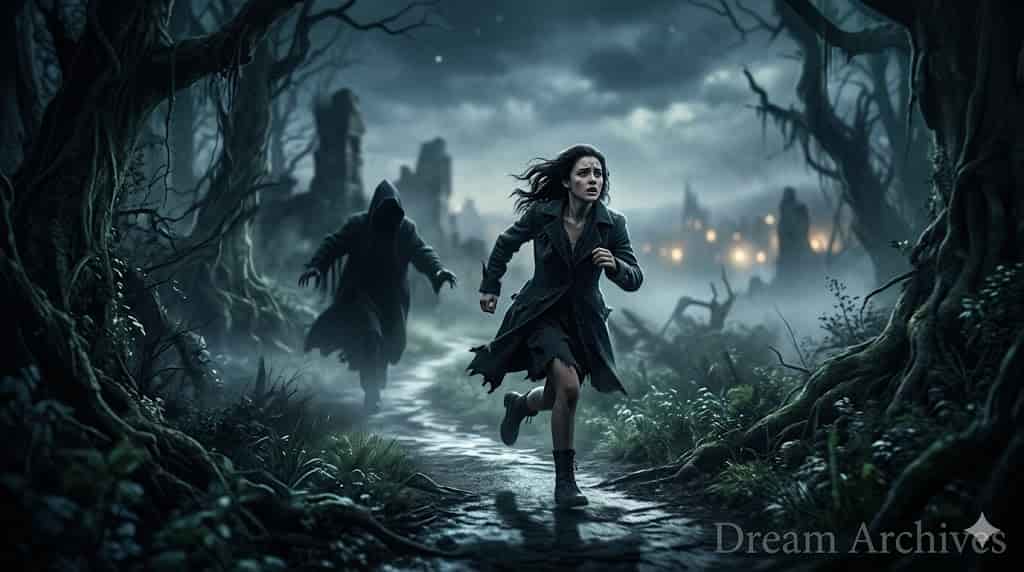
Being Chased Dreams: The Architecture of Fear, Lost Places & Why You Can't Run

In the theater of nightmares, the stage is not passive. When you are chased, the very walls, floors, and doors conspire against you. This is an exploration of why your brain builds mazes when you are afraid.
Introduction: When Space Becomes the Antagonist
In the vast majority of dream interpretation literature, the focus of a "being chased" dream is squarely on the pursuer. Is it a monster? A killer? A shadow figure? A wild animal? We obsess over the identity of the chaser, believing that naming the beast will tame the fear. But for a significant subset of dreamers—perhaps as many as 40% based on our internal database analysis—the true terror isn't who is chasing them, but where they are running.
Consider the sensation: You sprint down a corridor, but it stretches endlessly, the finish line receding faster than you can run. You grasp a door handle, twisting frantically, but it refuses to turn, or worse, it opens to reveal a solid brick wall. You turn a corner, expecting an exit, only to find yourself back in the room you just left. The room behind you vanishes into darkness the moment you pass through it. The stairs loop upon themselves in an impossible spiral.
This is the realm of Dream Architecture. In these moments, the environment ceases to be a passive backdrop. It becomes a dynamic, hostile entity, actively designed to trap you. The physics of the waking world dissolve, replaced by a logic of anxiety where distance is elastic and exits are illusions. This article dives deep into the psychological, neurological, and symbolic meanings of these spatial distortions. Why does your brain construct mazes when you are afraid? What do these "lost places" reveal about your waking life decisions, your sense of direction, and your feeling of being trapped?
"In nightmares, architecture is not a setting; it is an antagonist. The walls do not close in to crush you physically; they close in to ask a terrifying question: 'Where do you think you are going, and why do you believe you can leave?'"
— Dr. Julian Harrow, The Psychology of Dream Spaces
We will explore the concept of Non-Euclidean dream geometry, the eerie phenomenon of Liminal Spaces, the symbolism of doors and stairs, and how different cultures visualize the "trap." By understanding the blueprint of your fear, you may find the key to the exit.
Non-Euclidean Nightmares: The Physics of Panic
In standard geometry (Euclidean), parallel lines never meet, and the shortest distance between two points is a straight line. In your dreams, especially when chased, these rules are not just bent; they are shattered. This phenomenon, which we call Non-Euclidean Dream Space, is one of the most distressing elements of pursuit nightmares.
The Stretching Corridor
Perhaps the most common variation: you are running down a hallway, and with every step you take, the hallway extends. The door at the end seems to move further away. This isn't just a trick of perspective; in the dream, you feel the futility in your muscles. You are sprinting at full speed, yet making no ground.
Psychological Interpretation: This is the spatial manifestation of futility and avoidance. Your subconscious is illustrating that your current method of escaping a waking-life problem is mathematically impossible. You are expending energy (running), but the resolution (the exit) is receding at the same rate. This often happens when you are trying to "outrun" a deadline, a difficult conversation, or an emotional truth without actually addressing the root cause. The harder you try to ignore it, the further away the solution gets.
The Looping Path
You run around a corner, then another, only to realize you are back in the exact same spot. The scenery is identical. The chaser is still behind you, perhaps closer now. This is the Ouroboros of Anxiety.
Psychological Interpretation: This represents circular thinking. You are having the same argument with your partner for the tenth time. You are worrying about the same financial issue without taking action. You are stuck in a mental loop. The dream architecture is telling you: "Your current path leads only back to the start. You must break the pattern, not run faster."
Shifting Rooms and Vanishing Exits
You run from a bedroom into a living room, but when you look back, the bedroom is gone. Replaced by a blank wall or a drop into a void. Or, the layout of the house changes completely—a door that led to the kitchen now leads to a basement.
Psychological Interpretation: This signifies instability in your foundational identity. The "house" in dreams often represents the self. If the rooms are shifting, it suggests you feel your sense of self or your home life is unstable. You cannot rely on your usual coping mechanisms (the familiar rooms) because they keep changing or disappearing. This is common during major life transitions: divorce, moving to a new city, or career changes where your old identity no longer fits.
Liminal Spaces: Airports, Hotels, and the Void
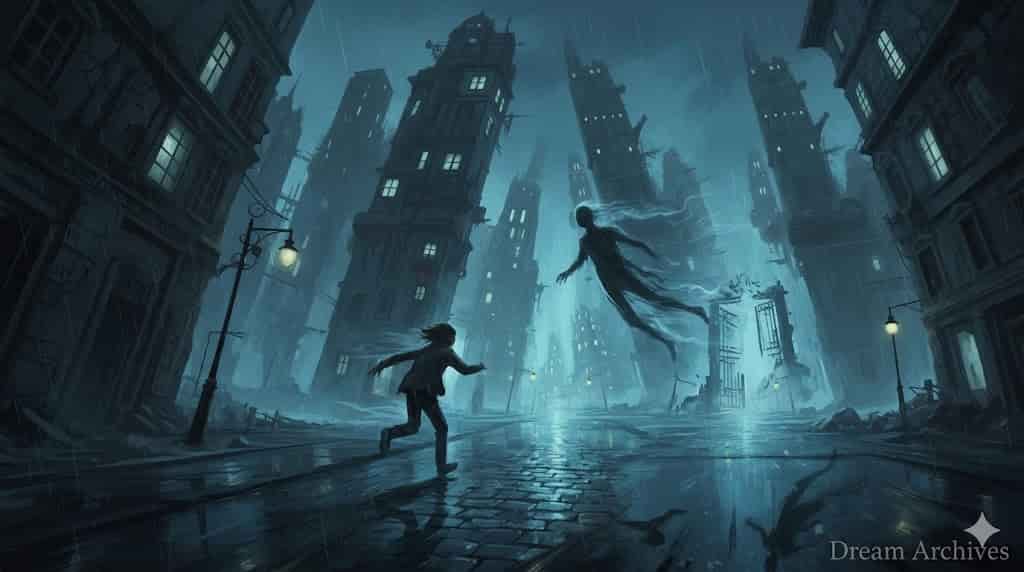
A specific and increasingly common subset of chased dreams takes place in Liminal Spaces. These are transitional locations: empty airport terminals at 3 AM, endless hotel corridors with identical doors, vast shopping malls with no shops open, or schools with no classrooms. They are characterized by their emptiness, artificial lighting, and a sense of "in-betweenness."
Why These Places?
Liminal spaces represent transition states in waking life. You are not where you were, but you are not yet where you are going. You are between jobs, between relationships, between versions of yourself. In a chased dream, being pursued through a liminal space suggests you are afraid of the transition itself.
The Chase Dynamic in Liminality
Unlike a chaotic city street, liminal spaces are eerily quiet. The sound of your own footsteps echoes loudly. The chaser's footsteps are amplified. There are no bystanders to help you. This amplifies the feeling of isolation. You are alone in this struggle.
- The Endless Hotel: Hotels are temporary homes. Dreaming of being chased here suggests you feel you have no permanent safe haven. You are constantly "checking out" before you can settle in. It reflects a fear of commitment or a lack of grounding.
- The Empty Airport: Airports are about departure and arrival. Being chased here often indicates anxiety about a looming departure (leaving a job, ending a relationship) or a fear that you will miss your "flight" (opportunity). The chaser is the ticking clock.
- The Void School: Schools represent learning and evaluation. An empty school suggests you feel unprepared for a "test" in life, but there are no teachers to guide you, only the threat of failure.
The Door Paradox: Locks, Handles, and the Illusion of Exit
The door is the ultimate symbol of transition in dreams. It is the boundary between safety and danger, known and unknown. In chased dreams, doors almost always malfunction. This "Door Paradox" is rich with symbolic meaning.
Scenario 1: The Handle Won't Turn
You grab the handle, twist it with all your strength, but it's locked. No matter how hard you try, it won't budge. The chaser is steps behind.
Meaning: You feel blocked by external forces. You see a solution or an opportunity in waking life, but something outside your control (a boss, a law, a partner's decision) is preventing you from accessing it. It creates a sense of powerlessness.
Scenario 2: The Door Opens to a Wall
You manage to open the door, expecting freedom, but there is a solid brick wall immediately behind it. Or a sheer drop into a canyon.
Meaning: This is the illusion of the "easy way out." You thought quitting your job, ending a relationship, or moving cities would solve your problems. Your subconscious is warning you: "There is no escape hatch. The problem is internal, not external. Changing location won't change the situation."
Scenario 3: Too Many Doors
You are in a hallway with hundreds of identical doors. You don't know which one leads out. You try one, it's a closet. Try another, it's a bathroom. The chaser is getting closer.
Meaning: Analysis Paralysis. You have too many choices in waking life, and you are terrified of picking the wrong one. The fear of making a mistake is immobilizing you. The dream suggests that standing still choosing is more dangerous than just picking one and running through it.
Scenario 4: The Revolving Door
You push through a revolving door, but you keep ending up on the same side. You cannot exit the building.
Meaning: Similar to the looping path, this indicates a cycle you cannot break. Often related to addiction, toxic relationship patterns, or repetitive negative thought loops.
Vertical Anxiety: The Staircase to Nowhere
Vertical movement in dreams carries heavy symbolic weight regarding status, ambition, and spiritual ascent/descent. Being chased up or down stairs introduces a physical exhaustion that horizontal running often lacks.
Running Up: The Lead Legs
You are fleeing up a staircase, but your legs feel like they are made of concrete or lead. You are moving in slow motion. The chaser is bounding up the steps effortlessly.
Meaning: This is the classic symbol of burnout. You are trying to "rise above" a situation, but your energy reserves are completely depleted. You are forcing yourself to climb when your body and mind are screaming for rest.
Running Down: The Loss of Control
You are running down stairs, but they are steep, crumbling, or endless. You feel like you are falling rather than running.
Meaning: Fear of losing status, "falling from grace," or descending into depression/chaos. The chaser behind you is pushing you toward a "lower" state of being.
The Broken Staircase
You reach a landing, but the next set of stairs is missing. A gaping hole blocks your path. The chaser is right behind you.
Meaning: A perceived lack of support. You feel the foundation of your life is crumbling beneath you. You don't know how to proceed because the "next step" doesn't exist yet.
Cultural Architecture: Mazes, Labyrinths, and Brutalism
Different cultures conceptualize the "trap" differently, and these archetypes appear in our dreams based on our cultural conditioning.
- The Greek Labyrinth: A single, winding path to a center (the Minotaur). Dreaming of this suggests a fated confrontation. You cannot get lost; the path is predetermined. You must face the monster at the center.
- The Hedge Maze: Full of dead ends and choices. This reflects modern anxiety about decision-making. Every turn is a gamble. Common among entrepreneurs or people facing complex moral dilemmas.
- The Chinese Maze Garden: Designed for contemplation. If you are chased here, it suggests you are rushing through a process that requires patience and reflection. You are trying to "solve" a spiritual issue with logic.
- The Brutalist Concrete Complex: Cold, windowless, industrial. Represents bureaucratic entrapment or feeling like a cog in a machine. The chaser is often "the system" itself.
- The Victorian Mansion: Filled with hidden passages. Represents the psyche's complexity. Being chased here often means you are exploring deep family secrets or repressed memories.
The Childhood Home: Distorted Memories as Traps
One of the most poignant settings for a chased dream is your childhood home. But it's never quite right. The hallway is too long. The stairs are in the wrong place. Your bedroom is now a dungeon.
Why the Childhood Home? It represents your foundational identity. When you are chased through it, it suggests that your current stressors are activating old wounds or core beliefs formed in childhood.
- The House is For Sale/Empty: You feel disconnected from your roots or that your old support systems are gone.
- Parents as Chasers (or Bystanders): Unresolved authority issues or a feeling that you must face your fears alone.
- The Room That Doesn't Exist: A newly discovered talent, a repressed memory, or a part of your personality that is emerging.
Case Studies: Trapped in the Mind's Blueprint
Case 1: The Hotel of Infinite Floors
Dreamer: Elena, 34, Architect | Frequency: Recurring (3x/week)
The Dream: "I was being chased by a faceless figure in a grand, old hotel. I ran to the elevator, but the buttons didn't work. I took the stairs, running up flight after flight. But every time I opened a door to a floor, it was just another identical hallway. I ran up 20 flights, maybe 50, but the 'Lobby' sign never appeared. The chaser's footsteps were echoing exactly one floor below me."
Waking Context: Elena was considering a major promotion that would require relocating. She felt a deep, undefined resistance.
Analysis: The "identical floors" represented her fear that changing cities wouldn't actually change her internal unhappiness. The "faceless figure" was her own ambition chasing her.
Resolution: She realized she wasn't running away from the promotion, but running in place. She negotiated remote work instead of moving. The dream stopped immediately.
Case 2: The School with No Exits
Dreamer: Marcus, 19, University Student | Frequency: During exam weeks
The Dream: "I was late for an exam. I was running through my high school, but all the exits were bricked up. Teachers were chasing me, silently, just walking fast. The hallways kept rearranging themselves like a Rubik's cube."
Waking Context: Severe imposter syndrome. He felt he didn't belong and was waiting to be "found out."
Analysis: The bricked-up exits showed he felt trapped by expectations. The rearranging halls reflected his confusion about his major. The silent teachers represented the judgment he projected onto himself.
Resolution: He realized he was forcing himself into a pre-med track his parents wanted. He switched majors to art. The dreams ceased.
Case 3: The House That Grew
Dreamer: Sarah, 45, New Homeowner | Frequency: One-off intense nightmare
The Dream: "I was being chased by a shadow in my new house. But as I ran, the house kept adding rooms. I'd run through a bedroom and suddenly be in a massive ballroom I'd never seen. Then a library. Then a dungeon. The house was growing faster than I could run."
Waking Context: Overwhelmed by debt and renovation stress on a "fixer-upper."
Analysis: The house literally represented her financial burden. The "growing rooms" were unforeseen costs. The house "swallowing" her was her fear of being consumed by debt.
Resolution: She rented out part of the house and scaled back renovations. Regaining control stopped the dream.
Reclaiming Space: Lucid Interventions
If you find yourself chased in a distorted architectural space, you are not powerless. Even without full lucidity, you can use mental shifts:
- Stop Running: In dream logic, the environment reacts to your intent. If you stop, the stretching hallway often stops stretching. Turn around and say, "This hallway doesn't need to be long."
- Create a Door: Don't look for an exit. Visualize a door appearing on a blank wall. Draw it in the air. Say, "Door, appear here."
- Change the Perspective: Imagine flying up above the maze. Seeing the pattern from above often reveals the exit immediately and diminishes the chaser.
- Ask the Building: Stop running and ask the wall: "What are you trying to show me?" The architecture might speak or morph into a symbol.
- Rewrite the Blueprint: If in your childhood home, force the dream to align with your real memory. "No, the stairs go there." Correcting the memory stabilizes the dream.
Frequently Asked Questions
Why do my dreams feel like video game levels?
Modern brains are trained on spatial navigation in games. If you game frequently, your brain uses those assets to build dream maps. It can also indicate a feeling that your life is "gamified" or lacks real stakes. However, if the "level" feels impossible to beat, it mirrors feelings of insurmountable obstacles in waking life.
Is dreaming of a haunted house different from a maze?
Yes. A haunted house implies the threat is inside the structure (past trauma, family secrets). The house itself holds the ghost. A maze implies the threat is the structure itself (confusion, lack of direction). In a haunted house, you might find a safe room; in a maze, nowhere is safe.
Can recurring architectural dreams mean I'm lost in life?
Often, yes. Recurring loops, endless corridors, or doors that won't open suggest a stagnation point. It's a strong signal from your subconscious that your current path is not working. It's time to evaluate your direction, make a decisive turn, or stop running and face the obstacle.
Why do I wake up with my legs twitching after these dreams?
This is a physiological carryover. During REM, your body is paralyzed (atonia), but the motor cortex is firing intensely as you "run" in the dream. Sometimes, small signals leak through, causing hypnic jerks or muscle twitches. It's a sign of how physically real the dream felt to your brain.
Does the style of architecture matter (e.g., modern vs. old)?
Absolutely. Old/Victorian architecture often points to past traumas or family history. Modern/Brutalist architecture usually relates to current work stress or societal pressure. Futuristic/Sci-fi architecture might relate to anxiety about the future or technology.
Still Running? Explore the Full Chase
From ancient labyrinths to modern algorithms, understand the full spectrum of fear:
Architecture of Fear: Mazes & Lost Places Digital Pursuit: Screens & The Algorithm