

MIRROR Dream Meaning: Jungian Psychology, Spiritual Portals & 9 Scenarios Decoded

The interpretations provided are for informational purposes only and do not constitute medical or psychological advice. For persistent concerns, please consult a licensed mental health professional.
These dreams emerge during identity questioning, career shifts, or relationship changes. The reflection represents who you are becoming—or fear becoming. This appears during major life transitions, where the old self no longer fits.
A mirror reveals what you avoid seeing. Distorted or absent reflections point to repressed emotions or disowned aspects of your personality (the Shadow) seeking integration. Just as wolf dreams expose primal instincts, mirror dreams expose raw psychological material.
Many traditions view mirrors as thresholds between the material and unseen dimensions. They may symbolize a portal to ancestral memory or consciousness, much like the liminal quality in moon dream symbolism.
Standing before a mirror can evoke being truly seen—often uncomfortably. This reflects waking-life situations where you feel exposed or compelled to present an authentic self you've concealed. The intensity can rival the rawness in spider dream encounters.
Psychology of Mirror Dreams & Jung’s Shadow Self
Depth Psychology & The Archetype of the Mirror
Carl Jung regarded the mirror as a potent archetypal image. Unlike symbols with singular associations, the mirror is fundamentally relational—it exists only in the act of reflection. In Jungian terms, a dream mirror often represents the inner guide mediating between the conscious ego and the unconscious Shadow.
Jung's Shadow Self encompasses everything you have repressed, denied, or hidden—not just negative traits, but unexpressed creativity, ambition, and vulnerability. When you gaze into a mirror and see something unfamiliar—a distorted face, a stranger, or no reflection—it signals the ego encountering a disowned aspect demanding recognition. The mirror marks the boundary between what you chose to see and what you refused to acknowledge.
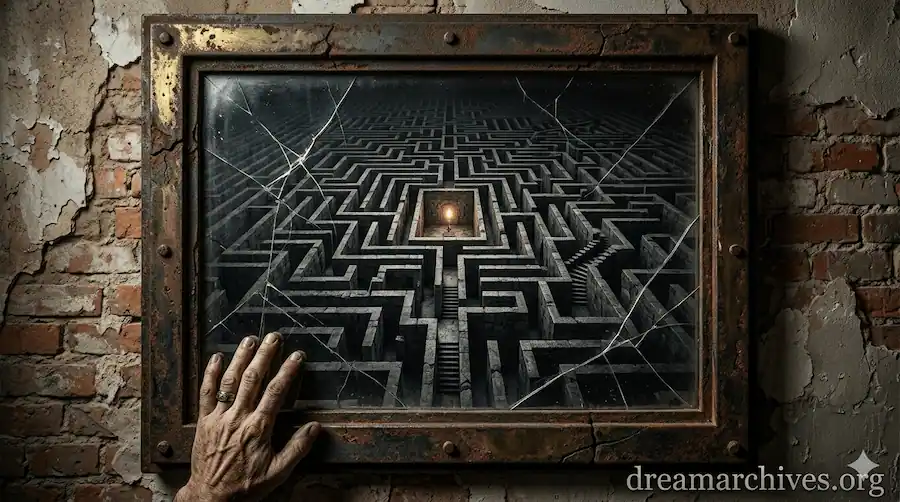
"The mirror does not flatter; it faithfully shows whatever it reflects. The confrontation with the mirror can be terrifying, because it shows us not who we think we are, but who we actually are at this moment."
This pattern appears when navigating emotional transitions—the end of a relationship, a career shift, or a crisis of meaning. The dream mirror offers a raw, unfiltered snapshot of your current psychological state.
Cognitive Processing & The Construction of Self-Image
Mirror dreams engage the brain's self-referential processing networks—particularly the medial prefrontal cortex and default mode network. During REM sleep, these regions reorganize memories, and the mirror emerges as a cognitive scaffold for self-evaluation.
Studies in Frontiers in Psychology suggest dream imagery related to self-perception intensifies during heightened self-scrutiny, like social media fatigue or workplace evaluations. The mirror is a neural representation of the brain's effort to update the self-model.
"Dreaming of a distorted reflection often reflects the natural cognitive dissonance that arises when your waking self-image conflicts with deeper, unexpressed feelings."
Cognitive theory suggests the specific distortion offers clues about which self-concept is under pressure. A stretched face may relate to feeling spread thin; an aged reflection connects to time passing; a childlike version could signal regression to a less burdened identity state.
Jung's Shadow Self & The Mirror as Confrontation Tool
The mirror is the most direct instrument for Shadow confrontation. Psychological health depends on integrating the Shadow—bringing repressed qualities into awareness so they stop operating through projection or self-sabotage.
In mirror dreams, the Shadow manifests as a dark figure, a stranger locking eyes with you, or a version of yourself engaged in frightening behavior. Its forced reciprocity—you cannot observe the Shadow without being observed by it—creates a pressure point for integration, also seen in certain bear dream encounters.
The recurrence of mirror dreams follows a pattern: the intensity of unresolved internal conflict (C) is proportional to the probability (P) of recurrence, expressed as P ∝ C². The more you avoid the material, the more persistently it returns.
Evolutionary & Threat-Simulation Theory
Recognizing one's reflection indicates self-awareness, a trait linked to complex social cognition. Antti Revonsuo's threat-simulation theory proposes dreams rehearse threats. A mirror showing something alarming may simulate losing social standing or attractiveness—profound evolutionary consequences.
The dream system uses the mirror to rehearse scenarios where self-perception is challenged—frequently surfacing in modern contexts like digital identity crises or body image struggles.
Dream Decision Tree: 4 Questions to Decode Your Reflection
Not all mirror dreams carry the same message. Use these guided questions to narrow down the meaning most relevant to your experience.
Clear & Bright ➜ Genuine self-honesty and emotional clarity.
Broken or Distorted ➜ Fragmented self-image, unresolved conflict, or a transitional period.
Yes — clearly ➜ Self-awareness and willingness to confront reality.
No — absent or invisible ➜ Erasure, identity loss, or emotional disconnection, frequently correlating with grief, burnout, or major life transitions.
Curiosity or Peace ➜ Openness to self-discovery.
Fear, Dread, or Shame ➜ Avoidance pattern—reluctance to fully acknowledge something about yourself.
No — it mirrored your movements exactly ➜ High self-awareness; conscious and unconscious selves are aligned.
Yes — the reflection acted on its own ➜ Repressed emotions or the Shadow Self are breaking through. The autonomous reflection is not "other"; it is the parts of you your ego refuses to acknowledge.
Common Mirror Dream Scenarios & Their Interpretations
The mirror's condition, what it shows, and your interaction with it dramatically alter its significance.

Seeing yourself with unusual clarity frequently emerges after an authentic decision or genuine self-acceptance. It may appear before a significant personal revelation. Some dreamers report this clarity resembles the expansive freedom in flying dream accounts.
While folklore links this to seven years of bad luck, psychologically it coincides with a breakup, career disruption, or any event fracturing your coherent identity. The dream processes emotional "shards." For individuals experiencing post-breakup identity confusion, this is a common image.
No one looks back. This unsettling experience commonly occurs during burnout, grief, or lost purpose. The absent reflection symbolizes disconnection between your inner state and outward persona, widening during family conflicts or caregiving exhaustion.
Your reflection is replaced by an unrecognized face. This carries a diagnosis-relevant signature: identity dysmorphia—a disconnect between your authentic self and the persona you perform. You've become proficient at being who others need you to be that your subconscious no longer recognizes you. In Jungian terms, the stranger represents the Shadow Self. Encounters with mirror strangers often precede breakthroughs in creativity and personal growth.
Obscured by fog or steam, making a clear view impossible. This arises during indecision—at a crossroads in career, relationship, or values. The fog represents unresolved ambiguity. Wiping it clean is often reported as a turning point coinciding with waking-life decisions.
A room lined with mirrors, each reflecting a different version of you. This reflects navigating multiple social roles—professional, parental, romantic, creative—and the tension between competing identities, frequently reported by those managing demanding professional environments alongside personal responsibilities.
View More Rare Scenarios
Your reflection speaks to you, offering advice or warnings. This may represent an internal dialogue between your conscious mind and deeper intuition during important decisions.
Deliberately destroying a mirror indicates active avoidance of self-confrontation—a desire to escape an uncomfortable truth or delay a necessary reckoning.
An antique or gilded mirror may symbolize ancestral patterns, inherited beliefs, or unresolved family dynamics influencing your self-perception.
A dark surface with no reflective quality suggests encountering unknown aspects of the psyche—fears, repressed memories, or emotions not yet brought to light.
Cultural Superstitions: From Portals to Omens
These interpretations reflect cultural and folk traditions for symbolic richness, not definitive explanations. Individual meaning is shaped by personal experience and current circumstances.
🧠 Western Psychoanalytic
Confrontation with the unconscious self. Wrestling with unacknowledged identity aspects not yet integrated into waking self-concept.
🐉 Chinese
Linked to the "照妖镜" (demon-revealing mirror), a protective talisman. Suggests hidden truths surfacing or a need to discern genuine intentions.
🏛️ Greek
The Narcissus myth deeply informs this symbolism. May indicate excessive self-focus or a healthy journey toward self-discovery.
🕉️ Hindu
Represents "Maya" (illusion of the material world). May suggest questioning surface-level reality or a spiritual awakening.
⛩️ Japanese
The "Kagami" is a sacred treasure symbolizing wisdom and truth. May suggest approaching clarity or receiving ancestral insight.
🕌 Islamic
Symbolizes the state of one's soul. A clean mirror reflects a clear conscience; a broken one suggests inner turmoil or unconfessed burdens.
View More Cultural Interpretations
🏰 Medieval European
Mirrors viewed with suspicion as tools of vanity or witchcraft. May suggest feeling judged by external appearances or tension between authentic expression and societal expectations.
🌿 Celtic
Reflective surfaces considered gateways to the Otherworld. May suggest sensing a thinning veil between everyday reality and intuitive awareness.
🌍 Indigenous African
Associated with ancestral communication. May suggest receiving messages from departed loved ones through the subconscious.
🗿 Mesoamerican
Obsidian mirrors associated with Tezcatlipoca served as portals to the spirit realm. May suggest accessing hidden knowledge or confronting a transformative inner force.
Spiritual Meaning: Are Mirrors Portals to Other Dimensions?
In esoteric traditions, the mirror is an active participant in self-transformation. "Shadow Work" positions the mirror as the primary tool for encountering disowned psyche aspects. A mirror in a dream isn't just a surface—it's a boundary between the conscious and subconscious, a liminal threshold where the hidden becomes visible.
When a mirror appears as a portal you can step through, it may reflect a spiritual opening, often coinciding with meditation, major life passages, or deliberate inner work. While no empirical evidence supports literal alternate dimensions, the subjective experience is psychologically significant.
Cat (The Observer): Cats perceive invisible frequencies. When a cat appears alongside a mirror, it suggests developing "night vision" to see through deceptive waking-life surfaces. The cat watches without being reflected, meaning it may see what the mirror conceals—indicating someone in your environment isn't what they appear.
Owl (The Truth-Seeker): The owl sees clearly in darkness. In a mirror dream, it signals hidden truths about to surface—truths that may be uncomfortable but necessary. The mirror and owl form a powerful pair: the mirror shows what is, the owl shows what it means.
From Mesoamerican scrying to medieval folk magic, mirrors are thresholds between worlds. A mirror dream may invite you to cross a psychological boundary you've feared. It carries a warning: what you find on the other side may permanently alter your self-understanding. The symbolism of roots in tree dreams offers a complementary perspective: the portal may lead deeper into your foundation.
Who Dreams of Mirrors? Age, Gender, and Life Stages
Interpretations shift depending on where you are in life.
🧑🎓 Teenagers & Young Adults
Particularly common during identity formation. A distorted reflection may correspond to body image concerns from social media comparison. This demographic reports the highest frequency of appearance-related anxiety dreams.
💼 New Professionals
May reflect imposter syndrome—the competent professional persona you present doesn't match the uncertain person you feel internally. The mirror reveals the gap between performance and self-perception.
🔄 Mid-Life Adults
Frequently involves seeing an older version of oneself. Corresponds to self-reckoning—evaluating achievements against earlier ambitions or reassessing priorities.
🎨 Creative Professionals
Often encountered during creative block or grappling with work authenticity. The mirror may represent the critical inner voice or unexpected inspiration.
Interpretation for Pregnant & Postpartum Individuals
A Mirror showing a different body may symbolize psychological adjustment to transformation that feels both exciting and disorienting.
Interpretation for Recent Breakup Survivors
The reflection may appear alone, incomplete, or merged with the former partner's image. This reflects re-establishing an independent identity—the self without the relationship.
Interpretation for Caregivers
Reflections often look exhausted, aged, or invisible, representing the loss of personal identity when others' needs overshadow your self-recognition.
Interpretation for Students Under Pressure
Reflections look unprepared or panicked, mirroring performance anxiety and fear of evaluation in high-pressure academic environments.
Interpretation for Entrepreneurs
May reflect a larger-than-life version (ambition) or diminished version (self-doubt) during financial uncertainty or growth scaling.
Interpretation for Retirees & Older Adults
Frequently involves looking at a younger version of oneself or seeing the reflection change across decades. This represents a life-review process—integrating past identities before the final chapters.
The Dreamer's Pivot
The smallest detail can redirect the entire meaning. Below are critical pivot points that can transform an interpretation from one theme to its opposite.
If it shatters accidentally—you bump into it or it falls—it suggests an external event is forcing a disruption in your self-concept. But if you deliberately break it—you pick it up and smash it—the meaning shifts toward self-liberation: consciously dismantling an old self-image that no longer serves you.
If you see no reflection while feeling panic or dread, it suggests a genuine identity crisis. But if you feel curiosity, peace, or relief, the meaning shifts toward a desire for liberation from self-image constraints—a wish to exist beyond defining yourself.
If the face is frightening or menacing, it represents a Shadow Self projection—a disowned, threatening aspect of your personality. But if the stranger appears calm, wise, or kind, it shifts toward an encounter with a deeper, integrated version of yourself—the Higher Self or inner guide.
If you cannot or do not attempt to clear it, it suggests passive avoidance of clarity—confusion related to financial anxiety or career ambiguity. But if you wipe it clean, the meaning shifts toward proactive self-clarification—reinforcing your capacity to cut through confusion.
Reader's Experience
"I kept dreaming of looking into a mirror and seeing myself at about 12 years old — the age when my parents divorced. After reading about identity fragmentation, I realized I had been unconsciously carrying that version of myself into every relationship. The dream stopped after I started therapy to address it."
"During my first year of running my own business, I had this recurring dream where I stood in front of a massive cracked mirror. It felt like the mirror was daring me to acknowledge that my confident 'founder' persona was built on constant anxiety. Once I started being more honest with my team about the challenges, the dreams changed."
"After my mother passed away, I had a dream where I looked in a mirror and my reflection was smiling warmly at me. I woke up crying, but it was the first time in months that the tears didn't feel hollow. I believe it was my subconscious telling me that the capacity for joy was still there, beneath the grief."
How to Respond to a Mirror Dream: Practical Advice
Spend a few minutes daily looking into a physical mirror and speaking directly to your reflection. The goal is compassionate self-acknowledgment. Saying "I see you, and I accept what I see right now" reduces the intensity of mirror dreams by building a grounded waking relationship with your self-image.
Write down not just what happened but how it felt in your body. Note the mirror's size, condition, and emotional state. Patterns reveal which life areas generate subconscious reflection. Especially valuable if recurring, as recurring dream patterns point to unresolved themes.
Ask yourself what in your current life is forcing honest self-examination. This might be a conflict with a family member, a performance review, or a social media post triggering self-scrutiny. Identifying the real-world correlate transforms a confusing dream into a practical insight.
Mirrors are one of the most reliable "reality checks." Next time you suspect you might be dreaming, look for a mirror. If the reflection is blurred, distorted, absent, or acts unusually, you've gained lucidity. You can consciously direct the experience. Mirror-based checks are more effective than light-based checks.
If your mirror dreams cause significant distress, recurring nightly, or accompanied by depersonalization, consider speaking with a licensed therapist specializing in dream analysis. Dreams are tools for self-understanding, not a substitute for professional support.
Dream Exploration Guide: 5 Questions to Ask Your Reflection
The emotional tone is often more revealing than the visual content. If you felt relief at seeing an empty mirror, that suggests a very different inner state than panic. Sit with the emotion before analyzing the image.
Mirror dreams rarely emerge in a vacuum. Look back 48 to 72 hours before. Were you in a situation triggering self-scrutiny—a social event, a presentation, or social media session? The dream mirror amplifies waking experiences of being observed or compared.
This bypasses analytical interpretation and engages imagination. Would you clean the fog? Replace the glass? Step through it as a portal? Your instinctive answer reveals what your subconscious is asking you to do in waking life.
Passive observation implies detachment, while an active or hostile reflection suggests the Shadow Self is demanding attention. If the reflection moved independently, consider what part of you is acting outside your conscious control.
A mirror is a tool of self-revelation. If the image was distorted, ask what aspect of your life feels "out of shape." If it was empty, where in your life do you feel invisible? The mirror reflects your current relationship with your authentic self.
Common Questions About Mirror Dreams
Is it bad luck to see a broken mirror in a dream?
The seven-year bad luck superstition originates from ancient Roman beliefs about the body's renewal cycle. In dream interpretation, a broken mirror symbolizes a fragmented self-image or a significant personal transition, often preceding growth.
Why does my reflection look different in a dream?
During REM sleep, visual processing operates differently. The dream reflection is constructed from emotional networks rather than direct visual input, which is why it may appear distorted, older, or unfamiliar, encoding information about your emotional state.
What does it mean to see a demon in a dream mirror?
In Jungian depth psychology, frightening figures often represent the Shadow Self—repressed aspects of your personality. It may indicate parts of yourself—assertiveness, anger, or vulnerability—that your conscious mind has been unwilling to acknowledge.
Can mirrors in dreams be portals to other dimensions?
Scientifically, no evidence supports literal portals. However, many traditions treat them as symbolic gateways to deeper consciousness. The subjective experience of stepping through one often accelerates personal growth or spiritual deepening.
Why can't I see my face in a dream mirror?
"Mirror blindness" may reflect erasure, identity dissolution, or emotional disconnection, commonly reported during grief or burnout, signaling the psyche is reconfiguring your sense of self.
Why do I keep having recurring dreams about mirrors?
Recurring dreams indicate the subconscious persistently drawing attention to an unresolved issue related to self-perception or authenticity. Recurrence diminishes once the concern is consciously engaged with.
What does it mean to see someone else in your mirror?
Seeing another person's face may represent psychological projection—attributing qualities originating within yourself to someone else. It could also suggest empathy, identity merging, or an encounter with an animus/anima figure. The identity of the person provides important context.
Should I be concerned if my mirror dreams are disturbing?
Disturbing mirror dreams are relatively common and reflect temporary stress. However, if frequent, intensely distressing, or accompanied by depersonalization, consult a mental health professional.
Written by the DreamArchives Editorial Team
For more information, visit dreamarchives.org.