

Dreaming About Cats: What Your Subconscious Is Trying to Tell You

TOC
- Quick Reference: Common Cat Dream Scenarios
- Introduction
- What Do Cats Generally Symbolize in Dreams?
- How Do 6 Cultures Interpret Cat Dreams?
- 1. Ancient Egypt: Divine Protection (Bastet’s Messengers)
- 2. Traditional China: Zhou Gong’s Dual Omens
- 3. Japan: Maneki-Neko Luck & Bakeneko Transformation
- 4. Celtic Folklore: Cat Sìth (Otherworld Guardians)
- 5. Sigmund Freud: Repressed Desires & Feminine Mystique
- 6. Carl Jung: Archetypes & Self-Discovery
- What Does Your Cat Dream’s Color Reveal?
- Can Cat Dreams Actually Guide Real Life? (2 True Stories)
- Step-by-Step: Figure Out Your Cat Dream’s Meaning
- How to Work With Your Cat Dream (Practical Tips)
- FAQ: Your Cat Dream Questions, Answered
- Wrapping Up
- Disclaimer
Quick Reference: Common Cat Dream Scenarios
🐱 Friendly Cat Rubs Against You
Possible Meaning: Inner peace, alignment with your intuition, self-care.
😼 Aggressive Cat Attacks/Scratches
Possible Meaning: Conflict, boundary issues, repressed anger.
🐾 Kittens Playing
Possible Meaning: New beginnings, creativity, vulnerable projects.
🐈⬛ Black Cat Stares At You
Possible Meaning: Shadow self, hidden feelings, spiritual protection.
🤍 White Cat Appears
Possible Meaning: Clarity, spiritual guidance, emotional healing.
🧭 Stray Cat Follows You
Possible Meaning: Neglected self, need for independence.
🏠 Multiple Cats In Your Home
Possible Meaning: Emotional overwhelm, unbalanced dynamics.
Data sources for scenario frequency and symbolic alignment.
Introduction
Ever woken up at 3 a.m. Googling “what does it mean when I dream about a cat”? You’re not alone. Cat dreams are the 3rd most-searched dream topic globally—and for good reason. These fuzzy night visitors aren’t just random brain firings or leftover thoughts of your couch companion. They’re messengers from your subconscious, carrying clues about unacknowledged feelings, hidden desires, and even untapped potential.
Here’s the thing: A cat’s meaning in your dream isn’t one-size-fits-all. It depends entirely on your relationship with cats (are you a lifelong ailurophile or secretly terrified of them?), the cat’s behavior, and even its color. A purring tabby curled on your lap means something way different from a hissing black cat blocking your path. Let’s break this down—no fluffy jargon, just real insights backed by psychology, culture, and even science.
What Do Cats Generally Symbolize in Dreams?
Before we dive into specific scenarios, let’s cover the core archetypes that cats represent in dreams. These aren’t just random ideas—they’re rooted in decades of psychological research and cross-cultural belief, drawing from how humans have interacted with cats for thousands of years.
1. Independence & Self-Reliance
Cats don’t beg for attention or follow rules they don’t like—and that energy translates directly to your dream state. If you dream of a cat that refuses to be held, it’s probably your subconscious nudging you to reclaim your own autonomy. Maybe you’ve been saying “yes” to every work request, neglecting your hobbies, or letting a partner call all the shots. The cat’s not being rude—it’s a reminder that your needs matter too.
2. Intuition & The Unseen
Cats can see in the dark, hear sounds we can’t, and sense shifts in energy before we do. In dreams, they act as guides to your unconscious mind—the part of you that knows things your logical brain can’t explain. A cat that leads you through a dark room? It’s telling you to trust that gut feeling you’ve been ignoring about a job, relationship, or big decision. That “I don’t know why, but this feels wrong” thought? The cat’s here to confirm it’s worth listening to.
3. The "Shadow Self" (Jungian Psychology)
Carl Jung—one of the founding fathers of modern psychology—called the “shadow self” the parts of us we disown: our anger, jealousy, fear, or even our secret ambitions. Cats, he believed, often represent this shadow. A hissing or scratching cat isn’t a sign of danger—it’s a call to confront the parts of yourself you’ve been hiding. Maybe you’re angry at a friend but too scared to say it, or you want to quit your job but fear failure. The cat’s here to say: Stop running from these feelings. They’re part of you, and acknowledging them is the first step to healing.
4. Feminine Energy (Anima/Animus)
Jung also talked about the “anima” (the feminine side of the male psyche) and “animus” (the masculine side of the female psyche). Cats, with their mix of softness and strength, often embody these archetypes. For a man, a dream about a gentle cat might be a push to embrace his emotional side—maybe he’s been suppressing grief or vulnerability. For a woman, a confident, strutting cat could be a reminder to step into her power—especially if she’s been downplaying her skills at work or in relationships.
How Do 6 Cultures Interpret Cat Dreams?
Cats have walked beside humans for 10,000 years—so it’s no surprise every culture has its own take on what they mean in dreams. These beliefs aren’t just old wives’ tales; they’re windows into how different societies see the line between the physical and spiritual worlds.
1. Ancient Egypt: Divine Protection (Bastet’s Messengers)
In ancient Egypt, cats weren’t just pets—they were sacred. Killing a cat, even by accident, was a capital offense, and cats were mummified and buried in sacred cemeteries alongside their owners. They were closely linked to Bastet, the cat-headed goddess of home, fertility, and protection. Bastet wasn’t just a symbol of warmth—she was a fierce guardian who warded off evil spirits and sickness from households.
For Egyptians, dreaming of a cat was a very good sign. It meant Bastet was watching over you, shielding your soul from harm as it traveled the underworld during sleep. A cat that curled up beside you in a dream? That was her way of saying, “You’re safe—no matter what darkness you’re facing.”
2. Traditional China: Zhou Gong’s Dual Omens
Traditional Chinese dream interpretation, codified in the Zhou Gong Jie Meng (The Duke of Zhou Interprets Dreams), sees cats as both lucky and tricky—their meaning depends entirely on what they’re doing in the dream.
- A cat catching a rat? That’s a sign of coming wealth—symbolizing your ability to outsmart obstacles and seize opportunities. Think of it like the cat catching a rat that’s been stealing your grain: you’re about to “catch” a win that’s been eluding you.
- An aggressive cat hissing or scratching? That’s a warning: someone close to you might be hiding a secret, or a small conflict could blow up into something bigger. It’s a nudge to check your relationships and set clearer boundaries.
3. Japan: Maneki-Neko Luck & Bakeneko Transformation
Japanese folklore balances two very different cat spirits—and both show up in dreams with powerful messages.
- Maneki-neko (Beckoning Cat): You’ve seen this cat in shop windows—paw raised, sitting pretty. In dreams, it’s a lucky charm, signaling unexpected money, a new job offer, or even a long-lost friend reaching out. Its origin story goes back to the 17th century: a cat outside a temple raised its paw to beckon a traveler, who then avoided a deadly lightning strike. The temple’s priest later made a statue of the cat to honor its protection—and the tradition stuck.
- Bakeneko (Shape-Shifting Cat): A cat with two tails that can turn into a human? Sounds scary, but it’s not a bad omen. A bakeneko in your dream means you’re ready for a big change—maybe ditching a toxic habit, leaving an unfulfilling job, or embracing a part of yourself you’ve hidden. It’s your subconscious saying: “You don’t have to stay small. Transform.”
4. Celtic Folklore: Cat Sìth (Otherworld Guardians)
Celts believed cats could walk between the human world and the Otherworld—the realm of fairies, spirits, and ancestors. The most famous of these is the Cat Sìth: a large black cat with a white spot on its chest, said to be a fairy in disguise.
Dreaming of a Cat Sìth is a big deal. It could mean a deceased loved one is sending you a message, or that you’re developing psychic abilities (like clairvoyance or mediumship) you didn’t know you had. But it’s also a warning: you might be ignoring a big life decision, or you’re not honoring your ancestors’ wisdom. The cat’s here to remind you: “The Otherworld is close—listen to the signs.”
5. Sigmund Freud: Repressed Desires & Feminine Mystique
Freud, the father of psychoanalysis, thought dreams were all about repressed desires—things we want but can’t say out loud. For him, cats symbolized feminine sexuality and mystery. A man dreaming of a cat rubbing his leg? That might be his subconscious longing for intimacy, or even a memory of his mother’s nurturing love. A woman dreaming of a hissing cat? That could be guilt or shame about her own sexual desires—feelings she’s been taught to suppress.
Not everyone buys Freud’s take (it’s pretty focused on sex), but it’s a reminder: even the most innocent cat dream can tap into deep, hidden emotions.
6. Carl Jung: Archetypes & Self-Discovery
Jung, a student of Freud who went his own way, had a more holistic take: dreams are about balancing your psyche, not just fulfilling desires. For him, cats were archetypes—universal symbols that show up in every culture’s stories and dreams.
- A calm, confident cat? That’s the “Self”—the integrated, whole person you’re trying to become. It means you’re on the right path to self-discovery.
- A lost or scared cat? That’s a sign you’re disconnected from your true self—maybe you’re living someone else’s life, or you’ve forgotten what makes you happy. The cat’s here to guide you back.
What Does Your Cat Dream’s Color Reveal?
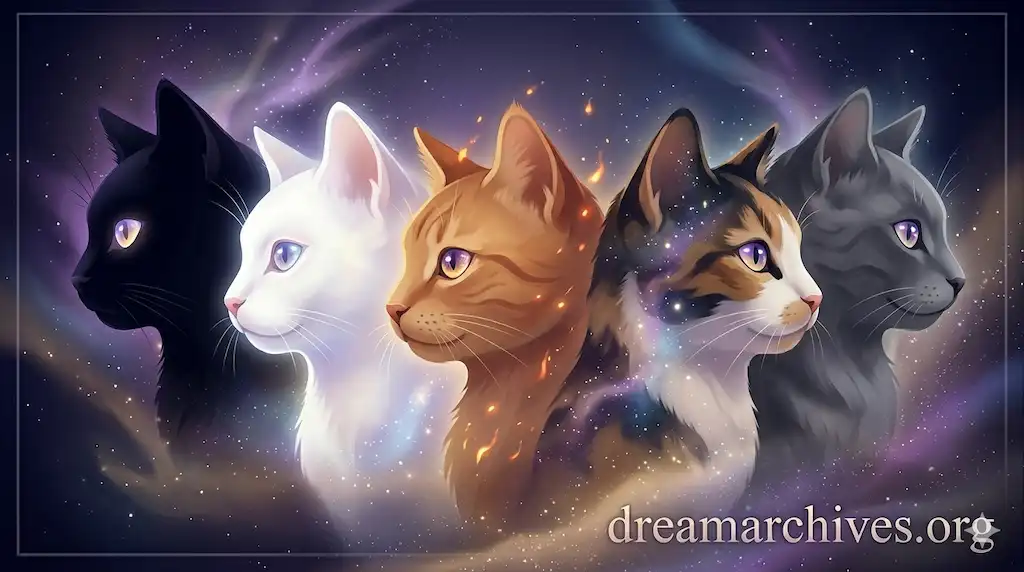
Color isn’t just a fun detail in dreams—it’s a clue. Research shows that the colors we remember in dreams aren’t random: they’re linked to our emotions, personality, and even neurological responses. Let’s break down the most common cat colors in dreams:
Black Cats
Forget the “bad luck” trope—this is one of the most misunderstood dream symbols. A black cat in your dream usually represents your shadow self: the parts of you you don’t want to admit exist (like anger, jealousy, or a secret ambition). It might also mean you’re going through a period of spiritual growth—one where you’re finally facing the things that have been holding you back.
Here’s the science: Studies of over 38,000 dream reports found that black is one of the most emotionally charged colors in dreams. We tend to remember black cats more vividly because they’re linked to intense feelings—whether that’s fear, curiosity, or even excitement.
White Cats
White cats are symbols of clarity, purity, and spiritual guidance. If one appears in your dream, it’s a sign you’re close to resolving a big problem, or that a spiritual guide (like a deceased loved one or guardian angel) is watching over you.
In Jungian psychology, white is the color of the conscious mind—so a white cat could mean you’re finally seeing a situation clearly, after months of confusion. It’s like turning on a light in a dark room: suddenly, everything makes sense.
Ginger/Orange Cats
Ginger cats are all about energy, passion, and joy. If you dream of one playing or chasing a toy, it’s your subconscious telling you to bring more fun into your life. Maybe you’ve been working too hard, or you’ve lost touch with the things that used to make you happy. The cat’s here to say: “Go outside. Play. Laugh. You deserve it.”
In color psychology, orange is linked to the sacral chakra—our center of creativity and pleasure. A ginger cat could be a sign that your creative juices are flowing, or that you’re ready to embrace more passion in your relationships.
Calico/Tabby Cats
Calico (three-colored) or tabby (striped) cats represent balance and diversity. Dreaming of one means you need to integrate different parts of your personality—like your work self and your creative self, or your logical side and your emotional side.
For example: If you’re a lawyer who loves painting but never makes time for it, a calico cat might appear in your dream to nudge you to pick up a brush again. It’s a reminder that wholeness comes from embracing all parts of who you are, not just the ones you think “should” matter.
Grey Cats
Grey is the color of neutrality—and grey cats in dreams represent a “grey area” in your life. Maybe you’re stuck between two choices (like taking a new job or staying at your current one), or you’re not sure how you feel about a relationship.
A grey cat might also mean you’re avoiding a decision because you’re scared of making the wrong choice. The cat’s here to push you: “You don’t have to have all the answers. Just pick a direction and start walking.” It’s okay to be unsure—sometimes, the act of choosing is more important than the choice itself.
Can Cat Dreams Actually Guide Real Life? (2 True Stories)
Enough theory—let’s talk about real people who used their cat dreams to make big changes. These stories show that dream interpretation isn’t just for psychics or academics—it’s a tool for anyone who wants to live a more intentional life.
Story 1: The Marketing Manager & The Black Cat
Sarah, 34, was a marketing manager at a Fortune 500 company, working 60-hour weeks and skipping meals to meet deadlines. She was exhausted, but she couldn’t bring herself to quit—she’d worked too hard to get where she was.
Then she started having a recurring dream: She’d be walking through her dimly lit office, her feet sinking into a carpet that felt like quicksand. Her colleagues’ voices would echo around her, but their faces were blurred—like she didn’t even recognize the people she worked with. Then a black cat with amber eyes would step in front of her, blocking her path. She’d try to walk around it, but it wouldn’t move. She’d wake up sweating, her heart racing.
She started seeing a Jungian therapist, who explained that the black cat was her shadow self—the part of her that was screaming for change. The dim office and blurred colleagues? That was her sense of disconnection from her work and herself. The cat wasn’t a threat—it was a messenger.
Sarah took small steps first: She started leaving work at 6 p.m. every day, reconnected with her old hobby of painting, and began therapy to explore her career goals. A month later, she had the dream again—but this time, the black cat stepped aside, and she walked through a door that hadn’t been there before. She woke up feeling calm, with a clear sense of purpose.
Today, Sarah works as a freelance graphic designer—and she says the black cat still appears in her dreams occasionally. Now, though, it’s not blocking her path. It’s sitting on her windowsill, watching her paint—like a quiet reminder of the courage it took to change her life.
Story 2: The Japanese Poet & The Bakeneko
In 1892, Yosano Akiko (then known as Yosano Hō) was a young Japanese poet living in a traditional household, constrained by the strict gender roles of Meiji-era Japan. She was married to a man she didn’t love, and she felt trapped by her duties as a wife and mother. She wanted to write poetry that challenged the norms of her time—but she was scared of what people would say.
Then she had a vivid dream: She was sitting in her garden, staring at the moon, when a bakeneko—a two-tailed cat—appeared. It transformed into a beautiful woman with cat-like eyes, who said: “You are not a prisoner. You have the power to shape your own destiny. But to do so, you must embrace the part of yourself that you fear.” Then the woman vanished, leaving only a single black feather.
Akiko was deeply moved by the dream. She began writing poetry that celebrated female sexuality, freedom, and self-determination—work that was considered scandalous at the time. Her most famous collection, Midnight Songs of the Courtesan (1901), challenged everything people thought women should write about. It made her one of Japan’s most important modern poets.
In her journal, Akiko wrote: “The bakeneko was not a monster. She was me—the part of myself that dared to speak, to desire, to be free. She taught me that transformation is not about becoming someone else. It is about becoming fully yourself.”
Step-by-Step: Figure Out Your Cat Dream’s Meaning
Interpreting a cat dream isn’t about finding a “correct” answer—it’s about exploring what the cat means to you. Here’s how to do it:
1. Write Down Everything (Immediately)
Dreams fade fast—within 10 minutes of waking up, we forget 90% of what we dreamed. So keep a journal by your bed, and as soon as you wake up, write down:
- The cat’s color, breed, and behavior (was it purring? Hissing? Playing?)
- The setting (your house? A forest? A dark alley?)
- How you felt (scared? Happy? Calm?)
- Any small details (like a collar on the cat, or a sound it made)
Even the tiniest detail can be a clue. For example: A cat with a bell collar might mean you’re being “called” to pay attention to something you’ve been ignoring.
2. Ask Yourself: What Does This Cat Remind Me Of?
Is the cat similar to a pet you had as a kid? Or does it remind you of someone in your life (like a friend who’s independent, or a colleague who’s “cattily” competitive)?
For example: If you had a tabby cat named Mochi that comforted you when you were sad as a child, a tabby cat in your dream might mean you’re craving that same comfort now—maybe you’re going through a tough time and need to be kind to yourself.
3. Connect It to Your Waking Life
What’s going on in your life right now? Are you stressed about work? Fighting with a friend? Trying to make a big decision?
Let’s say you’re considering a career change, and you dream of a cat leading you through a dark forest. That’s your subconscious telling you to trust your intuition—even if the path ahead is unclear. It’s saying: “You know what you want. Just take the first step”.
4. Use Jung’s "Active Imagination" Technique
Jung developed a practice called “active imagination” to connect with dream symbols. Here’s how to do it: Sit quietly, close your eyes, and visualize the cat from your dream. Then ask it a question—like “What do you want me to know?” or “Why are you here?”
Don’t overthink it—just let the answer come to you. It might be a feeling, a word, or even a sentence. For example: If you ask the cat why it’s blocking your path, you might suddenly feel a wave of anger—and realize you’re angry at your boss for overworking you. That’s the cat’s message.
How to Work With Your Cat Dream (Practical Tips)
Once you’ve interpreted your dream, how do you use that insight to make changes? Here are three actionable steps:
1. Journal About It (With a Twist)
Don’t just write down what the dream meant—write a letter to the cat. Tell it how you felt when you saw it, what you learned from it, and what you’re going to do next. This helps you process the dream on a deeper level—and it makes the insight feel more real.
For example: If the cat taught you to set boundaries, you might write: “Dear Black Cat, Thank you for showing me that I don’t have to say yes to everyone. Starting tomorrow, I’m going to say no to extra work that isn’t my responsibility. I’m going to take care of myself, too.”
2. Take Small, Intentional Action
You don’t have to quit your job or end a relationship—small steps are enough. If the dream told you to bring more creativity into your life, try painting for 15 minutes a day, or writing a poem before bed. If it told you to set boundaries, try saying “no” to one request this week.
These small actions add up. They send a message to your subconscious: “I’m listening. I’m ready to change.”
3. Track Your Dreams (For Patterns)
Keep a dream journal for a month, and look for patterns. Do cats appear when you’re stressed? When you’re happy? Do you always dream of black cats when you’re avoiding a decision?
Tracking your dreams helps you see how your subconscious is responding to your life. It’s like having a personal GPS for your mind—pointing you in the direction of healing and growth.
FAQ: Your Cat Dream Questions, Answered
We get a lot of questions about cat dreams—here are the most common ones, answered straight:
Q: Is dreaming about cats a good sign?
A: It’s not about “good” or “bad”—it’s about what the cat is doing and how you felt. A purring cat might mean inner peace, but a hissing cat might mean you need to address a problem. The dream’s job isn’t to predict the future—it’s to help you understand yourself better.
Q: What does it mean when a cat attacks me in a dream?
A: It usually means you’re feeling “clawed” by someone or something in real life—like a draining relationship, a toxic colleague, or unaddressed stress. It’s a sign to set boundaries: “This is too much. I need to protect myself”.
Q: Why do I keep dreaming about my dead cat?
A: This is your subconscious processing grief or missing the comfort your cat gave you. It might also mean your cat is sending a “I’m okay” message—letting you know that even though they’re gone, their love is still with you.
Q: What does it mean when I dream about multiple cats?
A: Multiple cats usually mean you’re feeling overwhelmed by emotions or social dynamics. Maybe you’re juggling too many responsibilities, or you’re feeling pulled in a million directions. It’s a sign to slow down and prioritize what truly matters.
Q: Do cats dream about us?
A: Probably! Studies show that cats (and other animals) dream about their daily experiences—including interacting with their owners. If your cat twitches or purrs in its sleep, it might be dreaming of curling up on your lap, or chasing a toy with you.
Wrapping Up
Cats have walked beside humans for thousands of years—guarding our homes, inspiring our art, and haunting our dreams. They’re not just animals—they’re mirrors, reflecting the parts of ourselves we can’t see, and guides, leading us toward healing and growth.
The next time a cat visits you in a dream, don’t just brush it off. Stop. Look. Listen. It might be carrying a message that will change your life.
Now it’s your turn: What’s the weirdest or most vivid cat dream you’ve ever had? Drop it in the comments below, we’d love to help you unpack it. And if you found this helpful, share it with a friend who’s ever woken up confused by a feline night visitor.
Disclaimer
This content is for entertainment, spiritual and educational purposes only. It is not professional psychological, medical or legal advice. If you are struggling with persistent nightmares or emotional distress, please seek the help of a qualified therapist or counselor.